


They've been our closest companions for thousands of years. They live with us, work with us, and even become part of our families, but can dogs understand our words and emotions? For a long time, despite dog parents' claims to the contrary, scientists and other experts believed that when a dog appeared to understand his pet parent, this was merely a combination of learned behaviour and the parent projecting human qualities onto the dog. But several recent studies have raised the question again, "do dogs understand humans?"
Research on Dog Cognition
Despite the fact that humanity has a long-standing close relationship with dogs, research into how dogs think and process information is fairly new. In his book How Dogs Love Us, Emory University neuroscientist Gregory Berns points to Charles Darwin as a pioneer in this field of study in the 1800s. Darwin wrote a lot about dogs and their expression of emotion and body language in his third treatise, "The Expression of the Emotions in Man and Animal." Phys.org points to the first major modern-day study conducted in the 1990s by Duke University's Associate Professor of Evolutionary Anthropology Brian Hare, then an undergrad student at Emory University. It wasn't until the 2000s that this field of study really took off, however. These days, it seems like new studies on how dogs understand and relate to people's words, emotions, and body language are coming out fairly regularly. The field of study has become so popular that Duke University even has a special area known as the Canine Cognition Center set up specifically for this purpose, under Dr. Hare's supervision.


Tasty Tips
Do Dogs Understand Humans?
So what has all this new research discovered? Can dogs understand us? It seems that all those dog parents insisting that their dogs do indeed understand them are right–at least partially.
Understanding Speech
 In 2004, Science magazine published a study about a border collie named Rico. Rico took the scientific world by storm by demonstrating his uncanny ability to "fast-map" new words. Fast mapping is the ability to form a rudimentary hypothesis about a word's meaning after a single exposure, an ability that's common to young children during their speech acquisition years. Rico learned the names of over 200 different items and was able to identify them by name and retrieve them four weeks after first learning them.
A more recent study conducted by researchers at the University of Sussex in England found that dogs not only pick up on emotional cues in our speech, but that they're also able to distinguish between meaningful words and gibberish. The 2014 study, published in an issue of the journal Current Biology, showed that dogs, like humans, use different parts of the brain to process these aspects of speech. More specifically, they process emotional cues on the right side of the brain, and meanings of words on the left side.
Understanding Body Language
A 2012 study in the journal PLOS ONE found that dogs can also understand human social cues to the point of being influenced by them. In the study, dogs were presented with two servings of food of different portion sizes. On their own, the majority of dogs naturally went for the larger serving. But once people got involved, things changed. It was shown that a person's positive reaction to the smaller portion could convince the dogs that the smaller serving was preferable.
In another 2012 study published in Current Biology, Hungarian researchers looked at the ability of dogs to interpret subtle forms of communication in humans. In the study, dogs were shown two different versions of the same video. In one version, a woman appeared to look at the dog while saying, "Hi, dog!" in a motherly tone before directing her gaze to a nearby pot. In the other version, the only difference was that the woman kept her gaze down and spoke in a subdued voice before looking at the pot. When shown the first version, dogs would pay attention to the woman and follow her gaze. Based on this reaction, the researchers determined that dogs have the same cognitive ability as a six- to twelve-month-old human baby when it comes to recognizing when they're being directly addressed and having information conveyed to them.
This may come as no surprise to Dr. Hare, the aforementioned head of Duke University's Canine Cognition Center, who conducted his own experiments on dogs and social cues as an undergrad at Emory in the 1990s. According to Phys.org, Dr. Hare's research found that dogs were better than our closest cousins, the chimpanzees, and even than human children at following subtle cues, such as pointing, bodily direction, and eye movement.
Understanding Emotion
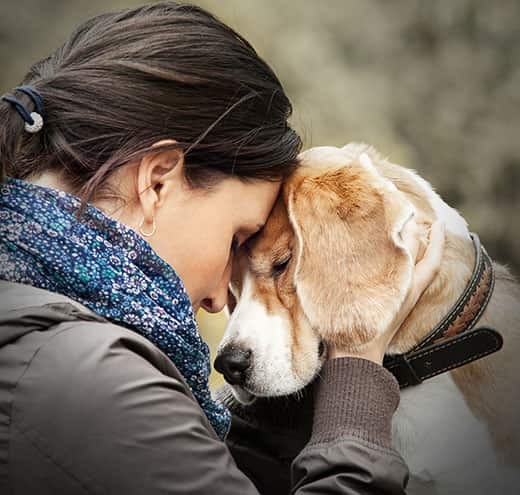 Earlier this year a study published in the British Royal Society journal Biology Letters made headlines for discovering that dogs have the ability to perceive and understand human emotions. Conducted in a joint effort by researchers from the University of Lincoln in the United Kingdom and the University of Sao Paulo in Brazil, the study found that dogs form abstract mental representations of positive and negative emotional states.
In the study, dogs were shown pictures of both humans and other dogs looking either happy or angry. The pictures were accompanied by audio clips of vocalisations that were also either happy or angry/aggressive. When the vocalisation matched the emotion in the image, dogs spent a significantly longer amount of time examining the facial expression in the image.
According to Dr. Ken Guo from the University of Lincoln School of Psychology, one of the researchers on the study, "Previous studies have indicated that dogs can differentiate between human emotions from cues such as facial expressions, but this is not the same as emotional recognition," reports ScienceDaily.
By combining two different sources of sensory input, however, these researchers have shown that dogs actually have the cognitive ability to recognise and understand emotions in humans.
Why Can Dogs Understand Us?
The reason why dogs are capable of understanding us so well remains a mystery, but most researchers chalk it up to a product of evolution and necessity. Dogs and humans have lived closely together for thousands of years, and in that time they've come to depend on us like no other species for their well-being. It's possible that selective breeding played a part, as dogs were chosen for breeding based on certain apparent cognitive abilities. In any case, it makes sense that a species that lives so closely with us and is so dependent on us would over time develop the ability to understand and communicate with us.
What Does This Mean For You and Your Pup?
Now that you have a better understanding of your dog's ability to comprehend not only your verbal words and commands, but also your emotional queues, what does this mean for you and your canine pal? First off, it gives you reassurance that your pup has the ability to learn more than just "sit," "stay," and "shake." Dogs have an amazing ability to pick up on hundreds of words such as Rico from above, or more recently Chaser, the dog that has learned more than 1,000 words. Chaser's ability to fast-map is incredible; she can pick out a toy based on context. If she is asked to find a toy that she doesn't recognise the name of from a pile of her regular toys, she understands that the one toy that she doesn't recognise must be matched with the name she doesn't recognise. This ability proves just how smart our canine companions are.
The other thing understanding the cognitive ability of dogs involves is their ability to pick up on social queues. Have you ever noticed that when you're having a rough day, your pup seems to stick close and tries to snuggle more? It is his way of saying that I understand that you're having a rough day, and I am here for you. Knowing this about your dog can help strengthen your relationship, as you learn to react to each other's emotional states and share the highs and lows together in true family fashion.
Can dogs understand us? Indeed, in many ways, they can. So the next time you catch yourself having a conversation with your dog and he seems to actually be listening, rest assured that it's not all in your imagination. Your dog might not understand every word or the exact meaning behind them, but your dog might get you better than you think. More importantly, your pup is capable of understanding that you love him, so there's no need to feel silly for telling him so.

Related products

Small & Mini Mature Adult 7+ Dog Food
Hill's Science Plan Small & Mini Breed Mature Adult Dog Food with Chicken is a complete pet food, specially formulated with ActivBiome+ Multi-Benefit Technology.
Tailored nutrition to support graceful ageing in small dogs. Specially made with a synergistic blend of nutrients for energy & vigor.

Perfect Digestion Small & Mini Adult Dog Food
Hill's Science Plan Perfect Digestion Small & Mini Breed Adult Dog Food with Chicken & Brown Rice supports ultimate digestive well-being & a healthy microbiome.
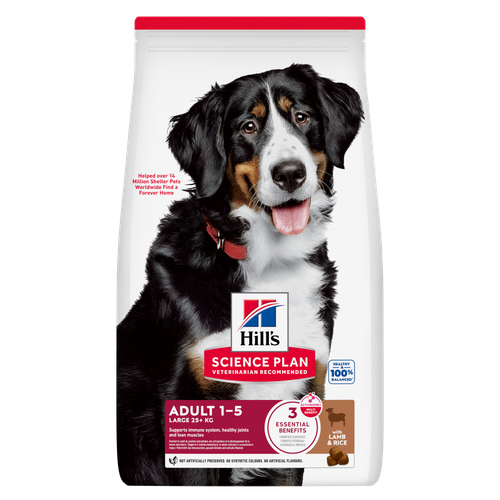
Large Breed Adult Dog Food
Hill's Science Plan Large Breed Adult Dog Food with Lamb & Rice is a complete pet food, specially formulated with ActivBiome+ Multi-Benefit Technology.
This food is specifically designed to fuel the energy needs of large breed dogs during the prime of their life.

Puppy Food
Hill's Science Plan Puppy Wet Dog Food with Chicken is a complete premium pet food for growing puppies from weaning until 1 year old and for pregnant and nursing dogs. This deliciously smooth minced chicken loaf is precisely balanced to deliver the appropriate amount of energy to support the needs of growing puppies.
Related articles

Kidney Disease in Dogs: Causes, Signs & Treatments
Discover the causes, signs, and treatments of kidney disease in dogs and find methods of supporting your dog's kidney health. Learn more at Hill's Pet South Africa.

The Science Behind Your Dog and His Behaviour
Discover how the field of dog science is giving us more and more insights into the inner workings of our furry best friends.

What should I do about my overweight dog?
Dog obesity is a significant problem - learn more about helping your dog become trimmer and healthier through improved nutrition.

Dog Bitten by a Snake? Clinical Symptoms & What You Should Do
Learn about snake bites on dogs, including clinical symptoms to look for, what to do if you think your dog was bitten, and treatment & prevention options.

Put your dog on a diet without them knowing
Our low calorie formula helps you control your dog's weight. It's packed with high-quality protein for building lean muscles, and made with purposeful ingredients for a flavorful, nutritious meal. Clinically proven antioxidants, Vitamin C+E, help promote a healthy immune system.
Put your dog on a diet without them knowing
Our low calorie formula helps you control your dog's weight. It's packed with high-quality protein for building lean muscles, and made with purposeful ingredients for a flavorful, nutritious meal. Clinically proven antioxidants, Vitamin C+E, help promote a healthy immune system.